Understanding "The Tell-tale Heart" Through the Narrative Triangle

Updated: Mar 21
Edgar Allan Poe’s "The Tell-tale Heart" is a masterclass in psychological tension and unreliable narration. Examining it through the lens of the Narrative Triangle reveals how every element of the story works together to create suspense, dread, and a haunting resolution.
As a reminder, the Narrative Triangle breaks storytelling into three apexes and nine supporting elements:
Story: Character, Plot, Narrative Drive
Context: Setting, Tools, Systems
Delivery: Style, Point of View, Reader Experience
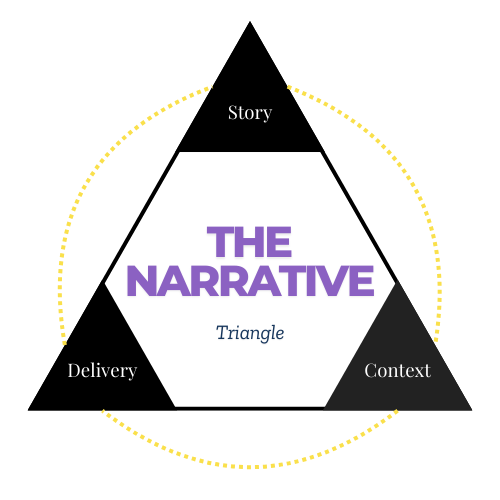
Let’s explore how Poe’s story aligns within this framework.
MAJOR SPOILERS BELOW.
If you haven’t already read "The Tell-tale Heart", please do so first. If you want to become a better writer, you need to rely on your own thoughts before those of others.
"The Tell-tale Heart" Narrative Analysis:
Note: 'The Tell-tale Heart" uses Delivery as its main apex, followed closely by Story.
Story: What Happens and Who It Matters To
Character
The story's narrator is complex: obsessive, paranoid, and unreliable. His moral and psychological instability drives the story. Meanwhile, the old man, although minor, represents innocence and becomes the focus of the narrator’s destructive obsession. Finally, the officers represent guilt and social pressures, which will be analyzed further in the Context Apex.
Plot
Throughout the story, structure is tightly controlled. Poe reveals the murder plot in a carefully paced sequence: the narrator telling us he isn’t mad, observing the old man, choosing the moment to act, committing the murder, feeling like he has successfully gotten away with the deed, but then ultimately confessing. Each beat is precise, using suspense and pacing to maximize tension and reveal character through action.
Narrative Drive
"The Tell-Tale Heart's" narrative drive comes from the narrator’s obsession and whether he will succeed or be caught. Guilt, paranoia, and the looming moral consequence propel the narrative toward its inevitable climax: confession and self-destruction.
Delivery: The Way the Story is Told
Style
The style of the work is largely voice-driven. Poe’s style is tense, repetitive, and rhythmically urgent. Short sentences and repeated phrases mimic the narrator’s escalating anxiety. The careful pacing reinforces the obsessive tone and keeps readers on edge.
Point-of-View
The story is told from a first person point-of-view. This is often the case for unreliable narrators; however, unlike with many unreliable narrators, Poe lets us in on the secret almost immediately when the narrator asks, “Why will you say that I am mad?” That combined with the reader’s knowledge that the narrator is dreadfully nervous, and his insistence that the “disease” has only made him better overall, automatically makes the reader experience unease.
Reader Experience
Poe manipulates the reader’s emotions through suspense, dread, and uncertainty. Every sound, especially the imagined heartbeat, is intensified. The reader experiences the narrator’s obsession and eventual breakdown, creating a visceral engagement that mirrors the story’s tension.
Tension is omnipresent, generated by the narrator’s insistence on his sanity while committing murder. Poe applies pressure through pacing, sentence structure, and repetition. The narrator’s frantic thoughts and hypersensitivity to sound create a constant sense of urgency and unease.
Readers interpret the story through the lens of psychological horror. The unreliable narration forces us to question reality: Are the supernatural elements real, or are they products of guilt and paranoia? Poe’s use of interpretation engages readers actively, making the story more than just a sequence of events.
Context: The World that Shapes the Story
Setting
The story’s setting is dark, claustrophobic, and entirely inside the home. This confined space amplifies tension and mirrors the narrator’s obsessive mental state. He has turned his full attention to his internal thoughts, and thus has little need for the outside world. The outside world presents a threat to his internal logic that he is justified in his actions. Because he is unable to face the outside world, the narrator is forced to find a hiding place inside, choosing the floorboards. This sets up the remaining plot when the darkness, silence, and isolation create an oppressive environment, which heightens every sound. When the old man’s heartbeat becomes terrifyingly amplified and the outside world forces itself inside in the guise of officers, the narrator is forced to face his guilt.
Tools
The narrator’s tools are both physical and mental. Physically, he uses his youth in comparison to his victim, a bed, a knife, and stealth to carry out the murder. Mentally, his tools include meticulous planning and heightened senses. These tools are constrained by his paranoia and guilt, which shape his actions and decisions. If the main character’s tools had no limits or costs, the story would not be nearly as powerful.
Systems
The story revolves around the narrator and the old man. Their relationship is defined by fear, obsession, and secrecy. Social norms or external authorities exist only in the periphery; the psychological dynamic between the two characters drives the narrative, demonstrating how internal human systems can dominate over external ones. However, the very fact that the narrative starts with the main character trying to convince the reader that he is not only sane but justified, points to a gnawing tension within his own internal system that places weight on the larger world’s norm: murder is not justifiable.
The Triangle in Action
Using the Narrative Triangle highlights how "The Tell-tale Heart" is more than a suspenseful story. Context shapes the possibilities and limitations of the characters, delivery dictates the rhythm of tension and revelation; and story drives the moral and psychological weight.
When viewed through the Narrative Triangle, "The Tell-tale Heart" functions as a tightly integrated system. Every element reinforces the others. For example, the oppressive setting (context) amplifies the first-person paranoia (delivery), which fuels the obsessive plot (story). In Poe’s tale, the old man’s heartbeat is the intersection of all three apexes.
The Narrative Triangle provides a framework for demonstrating the precision behind Poe’s enduring mastery.
Comments